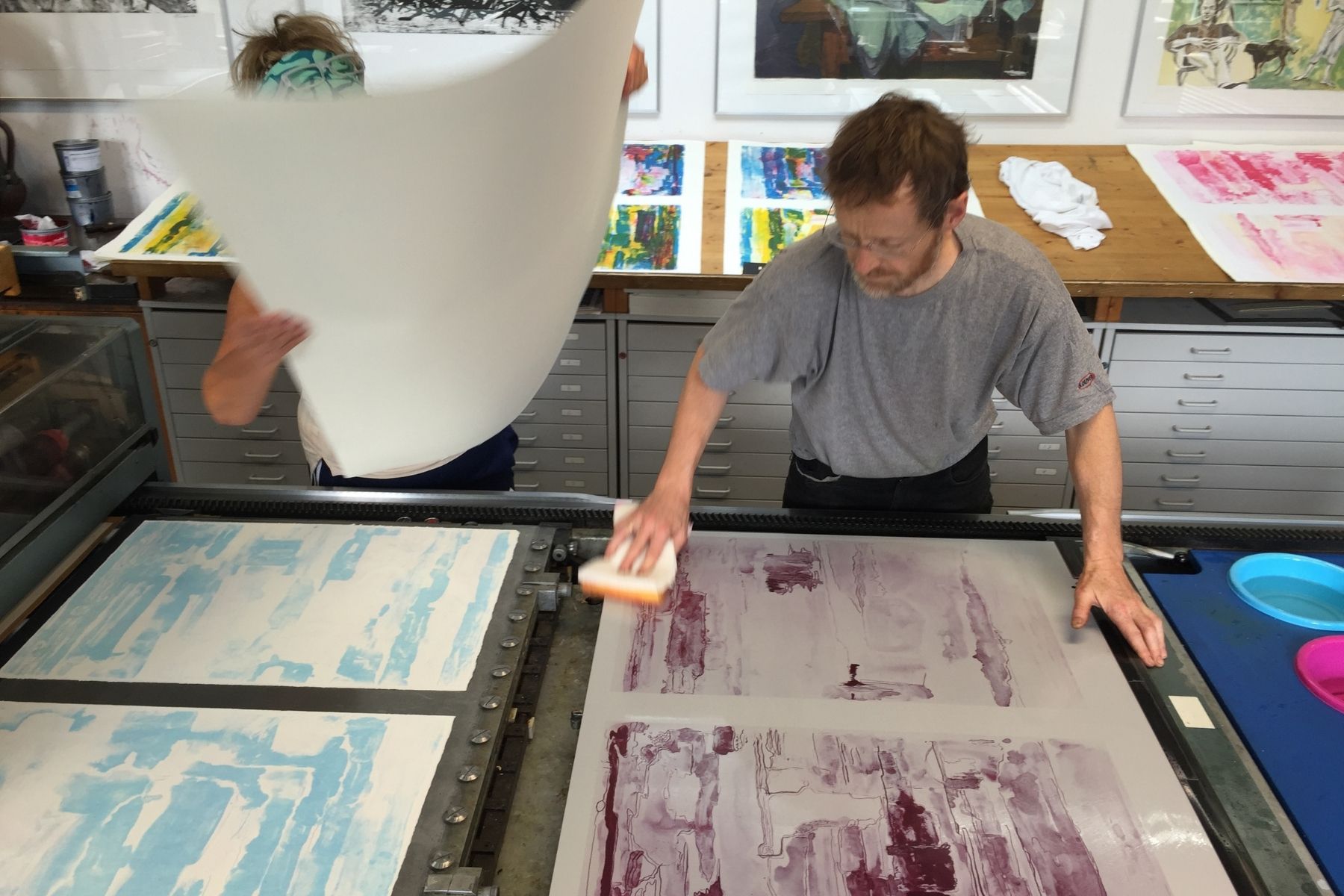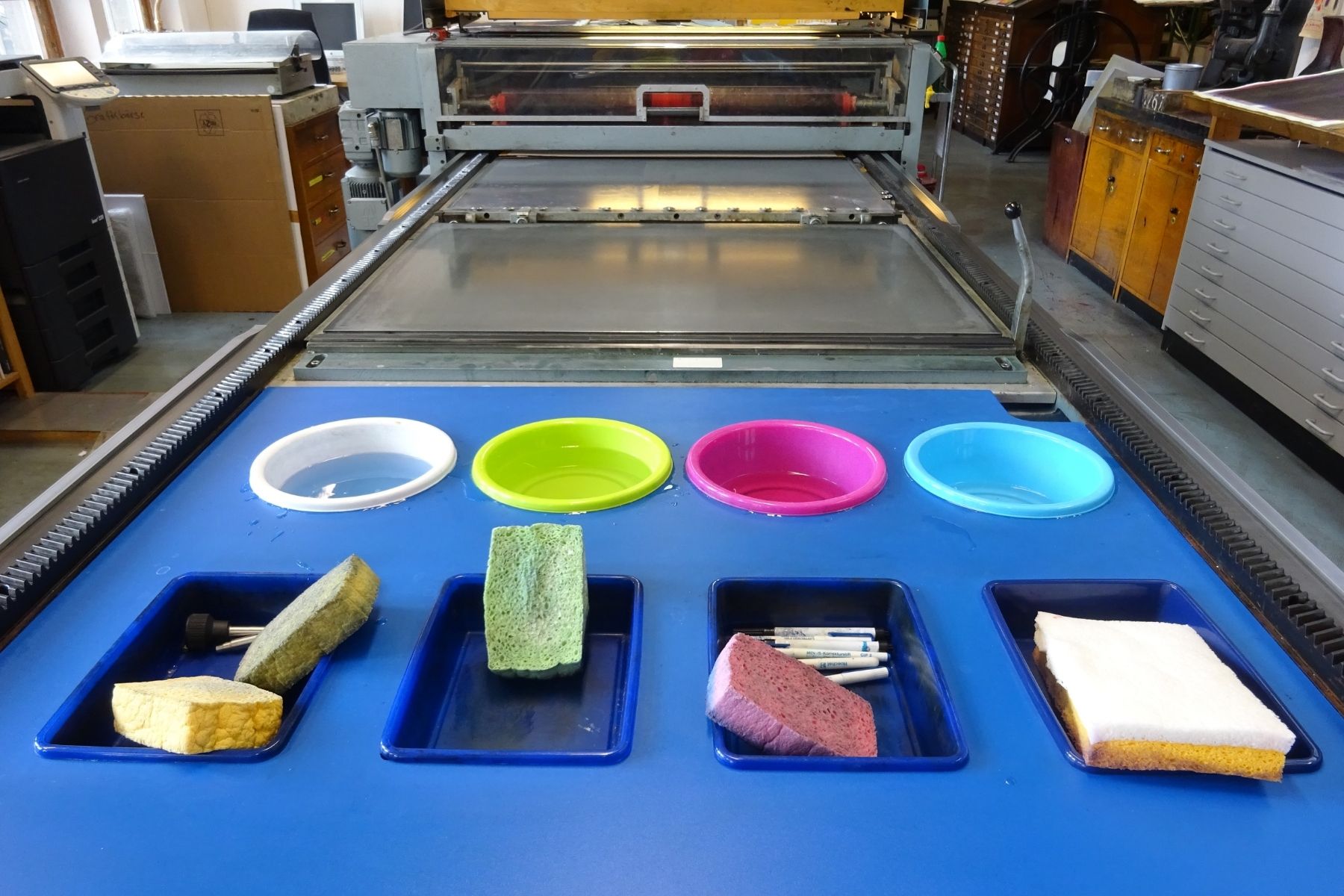
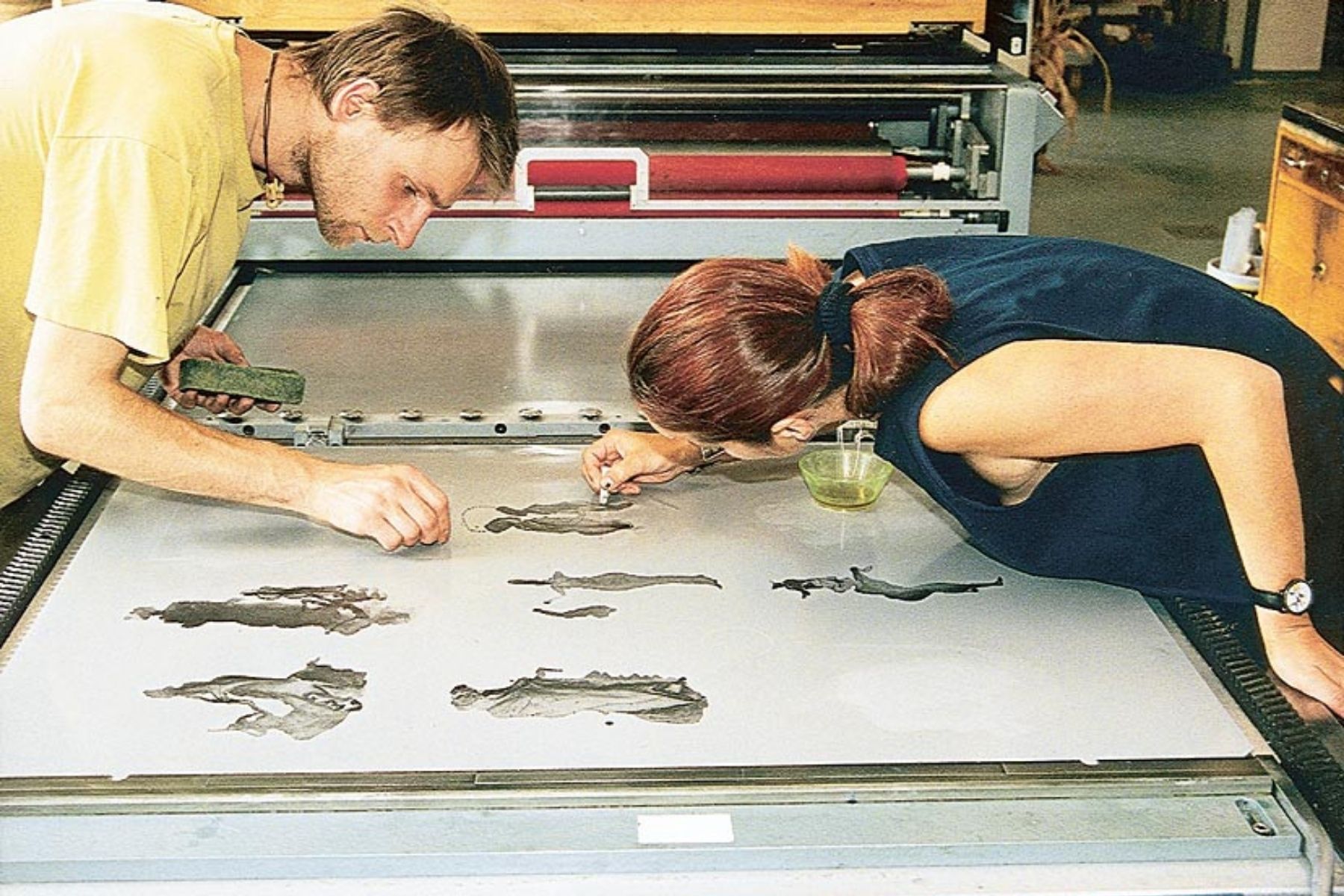
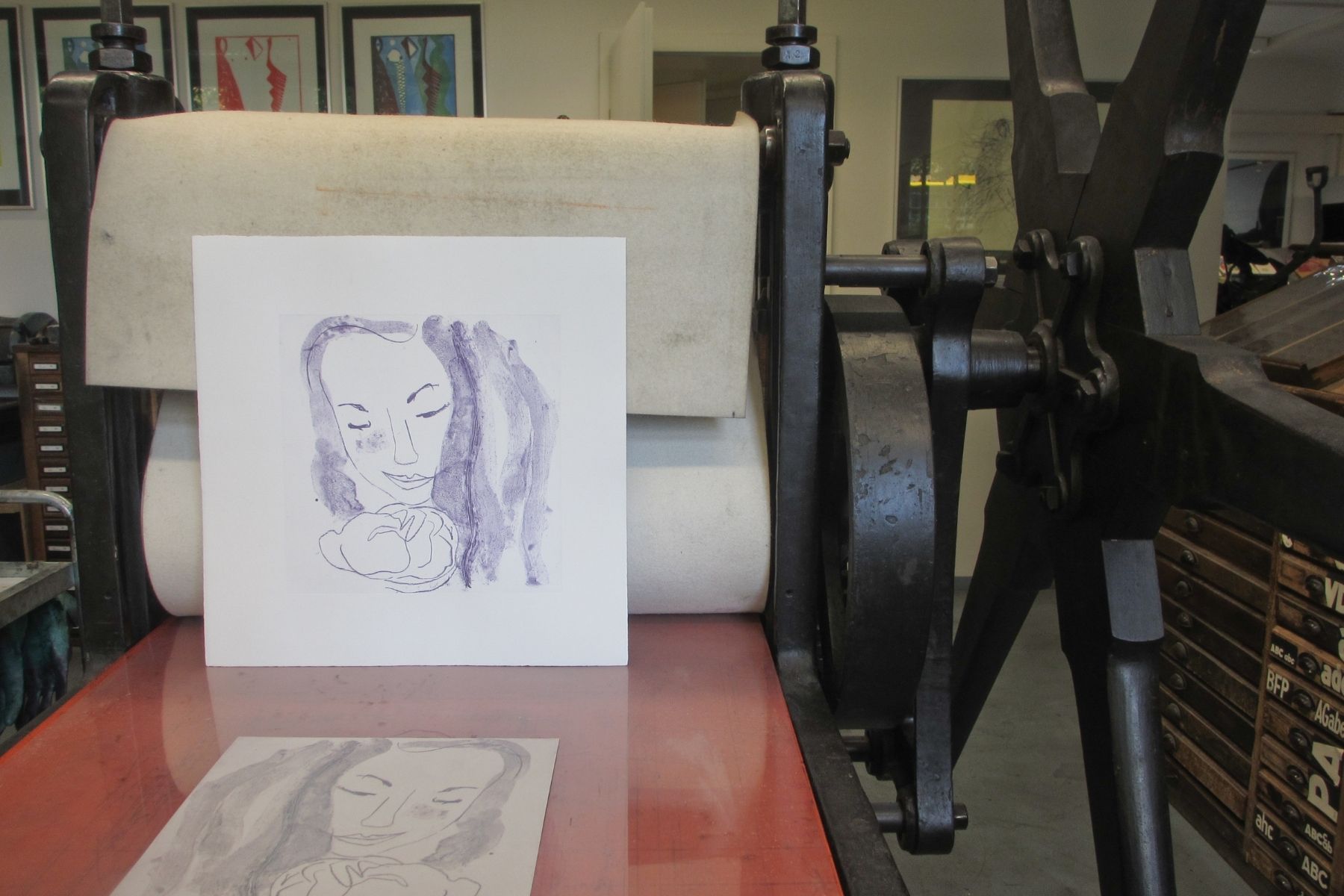
Using lithographic ink and crayon you draw directly onto a corn-surfaced aluminiumplate. You can work in various ways, even using thin washes of ink. It is also possible to work on matt transfer films and transparent paper with ink, crayon or copy markers. Collages, frottages and even direct photographic transfers of material structures onto the plates can bring fascinating results. The most important difference to stone lithography is that the original motif is not drawn in reverse. On top of this you may bring photographed motifs, typographic film and raster film into play or CtP–Plates in digital plate imaging for photokorn-algrafie.
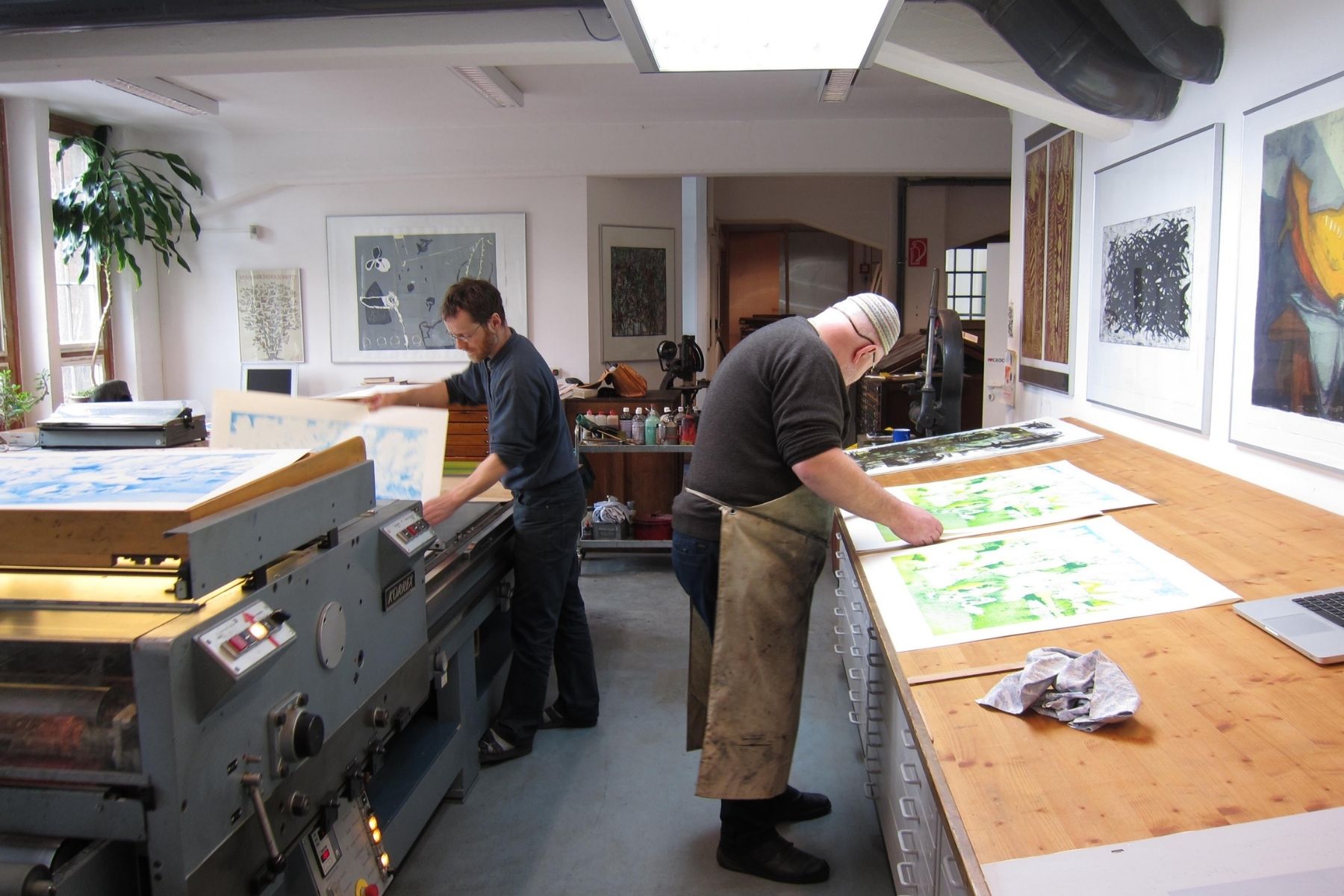
The plates are as easy to transport as paper and can even be taken out of doors. During the printing you can manipulate how the plate, the colour and what sort of paper is used. Algraphy is comparatively inexpensive as a basis for more complex stone lithographs, etchings and relief prints. We use a KORREX-proofprinting press with maximum paper format is 79 x 107 cm, under certain circumstances up to 100 x 140 cm. Directprint on KRAUSE and RICHARDSSONS-copper printing presses with a maximum paper format up to 110 x 160 cm.
Die Platten lassen sich wie Papier transportieren und eignen sich somit auch für die Verwendung unterwegs. Ein wesentlicher Unterschied zum Steindruck besteht im seitenrichtigen Arbeiten. Noch beim Drucken können Sie auf Plattenbehandlung, Farbe und Papier Einfluß nehmen. Farbdrucke für spätere Kombination mit Steindruck, Radierung oder Hochdruck sind sinnvoll. Papier bis 79 x 107 cm, bedingt bis 100 x 140 cm.
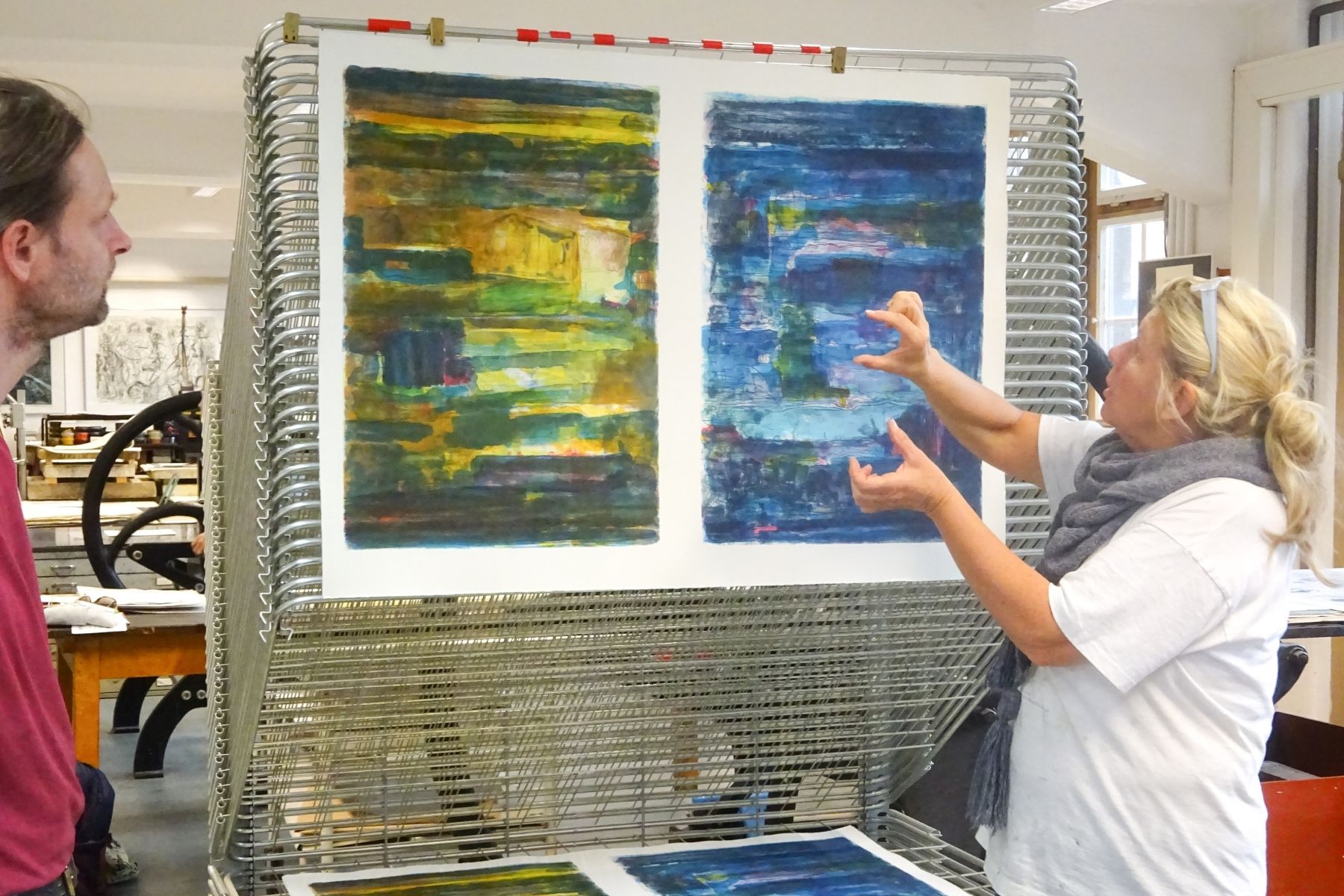
Hand Algraphy is printed on the copper printing presses up to 60 cm roller width, conditionally up to 110 x 160 cm. This special variant of Algraphy combines modern image media with classic original print graphics in an almost ideal way – drawn directly with lithotush and litho chalk or as a material print, transfer print, copy transfer, collage, frottage, photogram up to transfers of natural halftones in an exposure process without photographic or digital manipulations.
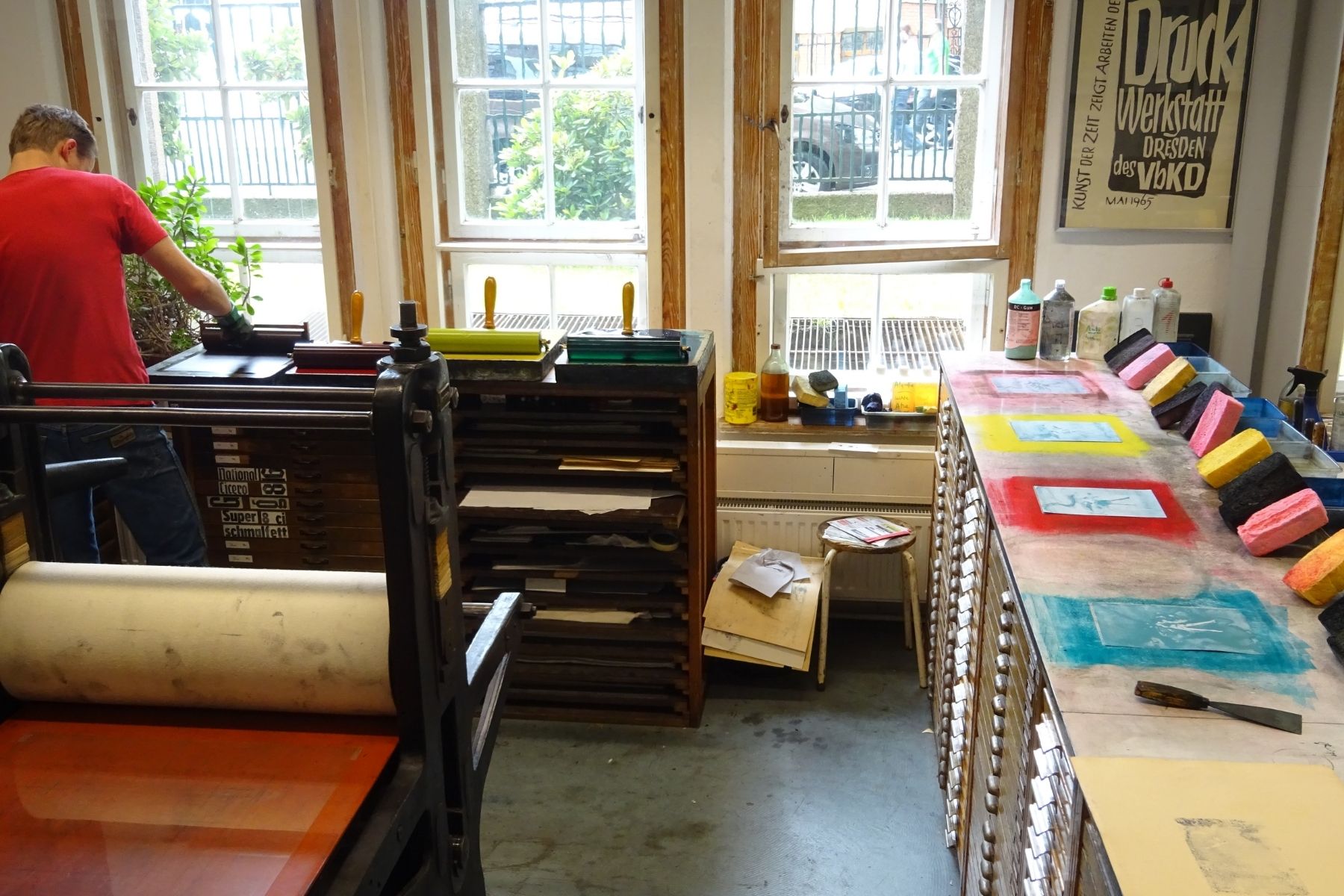
Phot-Grain Algraphy currently makes it possible digital plate imaging for Photokorn-Algraphy up to 46 x 103 cm. Printed in direct hand pressure on the copper printing presses or offset printing – with which the connection to the digital world is ideally established. To print original photographic image is using a stochastic photo grain raster, which can no longer be recognized as a raster even with a magnifying glass. The inclusion of photography and layout in traditional print graphics, etching and stone printing is hereby almost ideally possible for the first time in the highest quality.
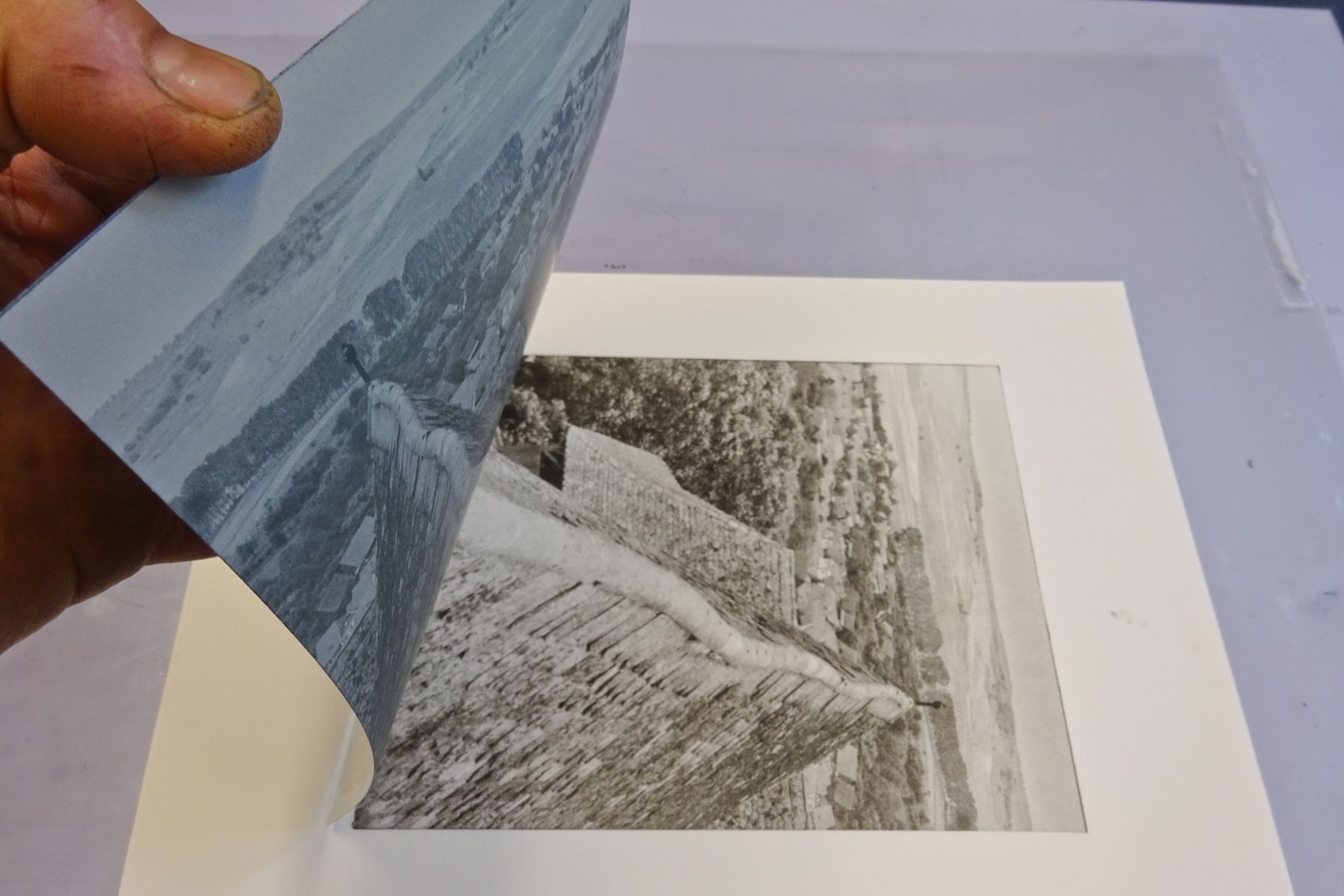
Das heißt: vom Bildschirm direkt an die Radierpresse! Ohne Qualitätsverlust durch Kopie auf Film etc. Seit 2019 schließen wir mit der „Fotokorn-Algrafie“ die Lücke zwischen digitaler Bildwelt und lithografischem Handabzug – mit direkter digitaler Bebilderung der Druckplatten (CtP). Die Technik dazu bieten wir (soweit bekannt) als erste Druckgrafische Werkstatt für künstlerische Anwendung modifiziert an. Durch die Benutzung des stochastischen Fotokorn-Rasters ist das Verfahren auch für originalgetreue fotorealistische Schwarz-Weiß Arbeiten empfehlenswert (siehe Mikroskopabbildungen unten) – und auf Grund der Feinheit in der Abbildung durchaus für alle anderen Bildideen, die in irgend einer Weise am Bildschirm entstanden sind. Es ist hier jedoch nicht von reproduktivem Druck die Rede.
Gedruckt wird auf gefeuchtetes Büttenpapier in direktem Hand-Druck, quasi wie in der Radierung. Auch der Zusammendruck von Farbplatten funktioniert naß in naß. Jede Farbe kann während des Druckens einzeln angepasst werden. Die Platte selbst verändert sich auch bei fehlerhaftem Einwalzen praktisch nicht und toleriert einiges an experimentellen Kapriolen.
It is possible to employ the Duplex or the 4c colour system even using thick deckle-edged etching papers. To be most faithful to the original the half tones may be reproduced using a frequency modulated raster and can be printed on CTP plates on a KORREX-proofprinting press. Each colour may be individually adjusted during the printing process. The maximum paper format 79 x 107 cm, under circumstances up to 100 x 140 cm.